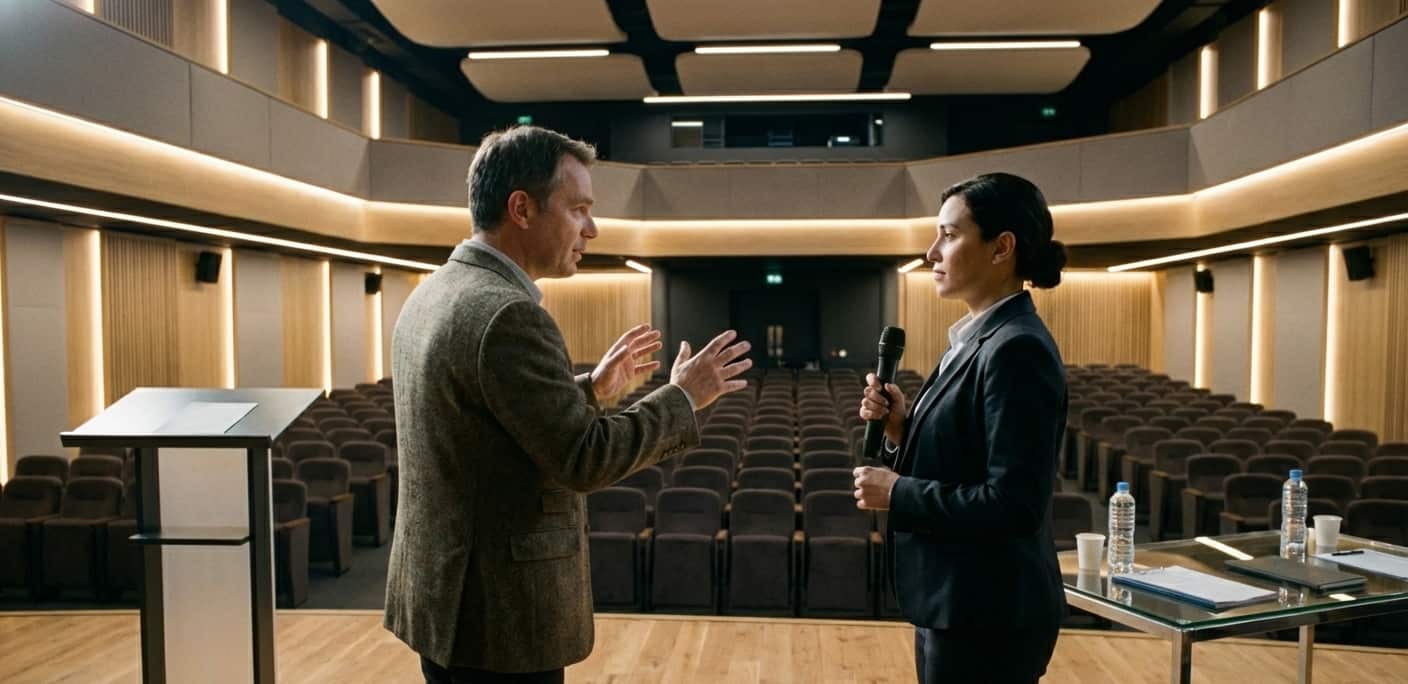
You're standing in the wings. Your heart is pounding. Your palms are sweating. Your mind is racing through worst-case scenarios. If this sounds familiar, you're not alone—you're part of a majority.
Research shows that approximately 75% of the population experiences some level of fear when it comes to public speaking. That's more than 200 million people who feel their stomach drop at the thought of standing before an audience. Studies indicate that between 20% and 40% experience a strong fear that significantly impacts their lives. In fact, public speaking consistently ranks as one of humanity's top fears—above spiders, heights, and in some surveys, even death itself.
The great writer Mark Twain once observed, "There are two types of speakers: Those who get nervous and those who are liars." Even the most polished presenters, the most confident leaders, the most eloquent speakers—they all feel it. The difference isn't that they've eliminated the fear. The difference is that they've learned to transform it.
The Hidden Cost of Unmanaged Fear
Consider what happens when presentation anxiety goes unchecked. Research reveals that 45% of individuals with glossophobia—the clinical term for public speaking fear—believe their fear has hampered their career growth. Countless talented professionals decline opportunities to lead meetings, avoid volunteering for presentations, and watch as less-qualified but more confident colleagues advance past them.
Students who could contribute brilliant insights remain silent in classrooms. Entrepreneurs with game-changing ideas struggle to pitch to investors. Leaders with vision fail to inspire their teams. The cost isn't just personal—it's measured in the billions of dollars spent treating anxiety disorders, in lost productivity, and in the countless innovations that never see the light of day.
But here's what research also tells us: this fear doesn't have to be permanent, and it certainly doesn't have to be debilitating.
The Surprising Truth About Nervous Energy
Studies in performance psychology have revealed something remarkable: anxiety and excitement are physiologically almost identical. Both emotions trigger increased heart rate, heightened alertness, and a surge of adrenaline. The only real difference is how we interpret these sensations in our minds.
When we label these feelings as fear, we activate a threat mindset that can paralyze us. But when we reframe them as excitement, we shift into an opportunity mindset that can propel us forward. Research from Harvard Business School demonstrated that people who reframed their anxiety as excitement actually improved their performance—not because they became less anxious, but because they changed how they viewed their nervous energy.
This is where a skilled coach becomes invaluable. A good coach doesn't try to eliminate your nervousness—they teach you to channel it. They help you understand that those butterflies in your stomach can become eagles that lift your presentation to new heights.
What Good Coaching Provides
A professional coach brings systematic approaches grounded in neuroscience, performance psychology, and proven practice. They teach you:
How to reframe your narrative. Instead of "I'm so nervous," you learn to say "I'm excited to share something valuable." This simple cognitive shift changes your entire physiological response and transforms debilitating anxiety into energizing enthusiasm.
How to prepare effectively. Research shows that 90% of presentation anxiety stems from lack of preparation. A coach provides structured frameworks for preparation and practice—not just rehearsing your content, but practicing at full performance energy, anticipating challenges, and building genuine confidence through competence.
How to use your body as an instrument. Through breathing techniques that activate your parasympathetic nervous system, power poses that boost confidence hormones, and vocal exercises that project authority, coaches help you harness physical techniques that directly counter anxiety's effects.
How to connect with purpose. The most powerful antidote to self-consciousness is focusing outward on your message and your audience. A coach shifts your attention from "What will they think of me?" to "How can I serve them with this message?" This redirection transforms nervous self-protection into passionate service.
The Path Forward
Studies on glossophobia treatment show that cognitive behavioral therapy, exposure therapy, and systematic coaching interventions are highly effective. People don't just manage their fear—they overcome it. Professionals who once trembled at the thought of presentations become speakers who command rooms. Students who avoided class participation become confident contributors. The transformation is real, measurable, and within reach.
The nervous energy you feel before presenting isn't your enemy—it's evidence that you care about your message and your audience. That caring is precious. With the right guidance, that same energy that once paralyzed you becomes the fuel that powers your most compelling, authentic, passionate presentations.
A skilled coach provides more than techniques—they provide a proven pathway from anxiety to confidence, from avoidance to engagement, from fear to power. They've walked this path with hundreds of speakers before you. They understand not just the mechanics of public speaking, but the psychology of transformation.
Your voice matters. Your ideas deserve to be heard. Your fear is simply energy waiting to be redirected. With the right coach, that redirection isn't just possible—it's inevitable.
The only question is: Are you ready to transform your fear into your greatest strength?
I'm rooting for you!
Coach Pete